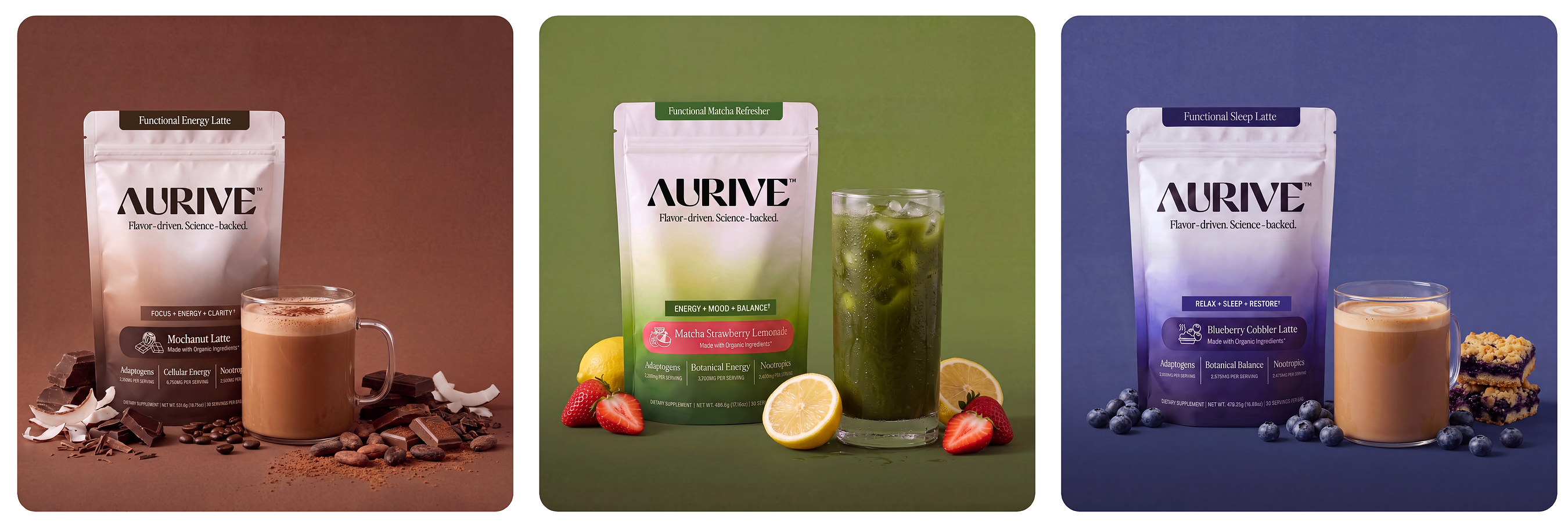
Aurive, a new Los Angeles-based functional wellness brand, has launched a three-product line of powdered drink blends formulated around adaptogens, functional mushrooms, and nootropic compounds, positioning each SKU for a distinct phase of the daily wellness arc. The direct-to-consumer brand was founded by Liz Benyo, a Doctor of Nursing Practice, and is available exclusively at AuriveWell.com.
The debut collection comprises Mochanut Latte (morning energy and cognitive clarity), Matcha Strawberry Lemonade (midday mood and balance), and Blueberry Cobbler Latte (evening relaxation and sleep support). A bundled Day-to-Night Collection packages all three for consumers seeking a complete circadian-aligned routine, retailing between $60–$145 on subscription or $80–$240 as one-time purchases.
Formulation Philosophy
Benyo's clinical background shapes Aurive's stated formulation approach: active ingredients are dosed to levels referenced in peer-reviewed literature rather than included in token quantities, a persistent criticism of the broader functional beverage segment. The brand uses concentrated standardized extracts designed for greater bioavailability compared to raw botanical powders, and all products are independently third-party tested for purity, potency, and contaminants. Full ingredient quantities are disclosed on-label — a direct contrast to the proprietary blend format still common across many competitor finished formulations. All inputs are plant-based, sustainably sourced, and manufactured domestically.
"It was equally important for me to create blends that were not only delicious and easy to integrate into daily life, but effective and backed by real scientific literature, not wellness trends," Benyo said.
Market Fit and Operator Context
Aurive's launch reflects broader structural tailwinds in the functional beverage category. Adaptogen and nootropic ingredient demand has accelerated as consumers seek alternatives to high-stimulant energy products, and functional mushroom ingredients — including lion's mane, reishi, and chaga — have moved from specialty channels into mainstream better-for-you beverage formats. The circadian-framing strategy (morning, midday, evening SKUs) mirrors positioning seen in established supplement stacks and is increasingly appearing in the functional RTD and powder-drink subsegment as brands attempt to increase purchase frequency and average order value.
The DTC-only launch keeps initial distribution tight, a common early-stage strategy for premium functional beverage brands managing ingredient cost and quality control. Subscription pricing at a discount to one-time purchase suggests the brand is prioritizing lifetime value and repeat usage — consistent with its "daily routine" positioning — over broad retail placement in the near term. Additional products are expected before year-end 2026.
For operators and formulators tracking the adaptogen and botanical beverage space, Aurive's transparent-label, clinically-dosed positioning represents a differentiator in a segment still crowded with underdosed blends. Brands targeting similar benefit claims — cognitive support, stress adaptation, sleep quality — face growing consumer scrutiny over whether ingredient levels actually align with clinical endpoints studied in the literature. Aurive's full-disclosure labeling approach may pressure category peers on transparency standards, a dynamic already reshaping supplement formulation norms across the nutraceuticals industry.
Written by Michael Politz, Author of Guide to Restaurant Success: The Proven Process for Starting Any Restaurant Business From Scratch to Success (ISBN: 978-1-119-66896-1), Founder of Food & Beverage Magazine, the leading online magazine and resource in the industry. Designer of the Bluetooth logo and recognized in Entrepreneur Magazine's "Top 40 Under 40" for founding American Wholesale Floral, Politz is also the Co-founder of the Proof Awards and the CPG Awards and a partner in numerous consumer brands across the food and beverage sector.