
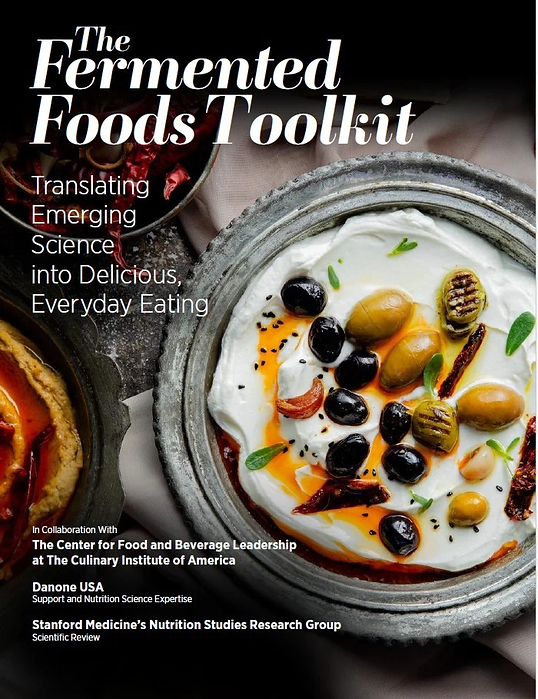
A new practitioner-facing resource aims to close the gap between fermented foods research and real-world application in clinics, teaching kitchens, and foodservice operations. Danone USA contributed nutrition science expertise to The Fermented Foods Toolkit: Translating Emerging Science into Delicious, Everyday Eating, developed by The Center for Food and Beverage Leadership at The Culinary Institute of America and independently reviewed by researchers affiliated with Stanford Medicine's Nutrition Studies Research Group.
The Science Behind It
The toolkit synthesizes the current evidence base linking fermented food consumption to gut health and chronic disease risk reduction, with particular emphasis on type 2 diabetes. Central to that evidence is the FDA's qualified health claim for yogurt and reduced risk of type 2 diabetes — the first such claim the agency has granted for yogurt — which followed a petition filed by Danone. Qualified health claims occupy a well-defined regulatory lane: they permit a structure-function-adjacent benefit statement on labeling when the scientific evidence is credible but not yet conclusive, making them a meaningful signal to both clinicians and formulators that the evidence base is maturing.
Beyond yogurt, the resource addresses the broader fermented foods category — kimchi, sauerkraut, miso, kefir — and includes visual learning tools designed to correct persistent consumer and clinician misconceptions, including the frequently conflated distinction between pickled and fermented foods and the mechanistic differences between prebiotics and probiotics. That clarity matters for operators: menu callouts and clinical recommendations only carry weight when the underlying science is communicated accurately.
Designed for Foodservice Operators
The toolkit's culinary component is explicitly practical, offering flavor-forward recipes and pairing ideas that integrate fermented ingredients into dressings, sauces, and grain bowls — formats that translate readily to institutional foodservice, hospital cafeteria menus, and restaurant R&D alike. Guidance is also structured around diverse dietary traditions and budget constraints, broadening potential adoption across community nutrition programs and retail foodservice.
"The challenge is not simply finding nutrition information — it's having the time, confidence and practical tools to turn that information into guidance people can use," said Kristen Rasmussen, MS, RDN, Program Director of Food is Life, Food is Health and Assistant Director of Health & Sustainability Programs at the Culinary Institute of America. The toolkit was designed to be usable during a patient visit, in a teaching kitchen, or in a foodservice planning session.
Amanda Blechman, RD, Director of Nutrition and Scientific Affairs at Danone USA, emphasized the company's broader intent: translating scientific evidence into formats that healthcare professionals can act on in everyday settings is central to the two-year Food is Life, Food is Health commitment Danone made as a founding exhibitor of the summit jointly hosted by the Culinary Institute of America and Stanford Medicine.
Market Context
The toolkit's release lands as fermented foods command growing attention across both the gut health and probiotic category and the broader functional foods market. Consumer interest in the gut-brain axis, immunity, and metabolic health has accelerated retail velocity for yogurt, kefir, and cultured vegetable products, while foodservice operators face increasing pressure from health-forward diners to substantiate wellness claims on menus. A credible, professionally endorsed educational resource that bridges peer-reviewed science and culinary application gives operators, registered dietitians, and menu developers a shared reference point — reducing friction in the translation from emerging evidence to plate.
For ingredient suppliers and finished-product formulators working in the fermented-foods space, the resource also reinforces the regulatory legitimacy of structure-function positioning for yogurt and broadens the conversational context to include kimchi, miso, and other traditionally fermented formats that have historically lacked the clinical documentation yogurt now carries.
Written by Michael Politz, Author of Guide to Restaurant Success: The Proven Process for Starting Any Restaurant Business From Scratch to Success (ISBN: 978-1-119-66896-1), Founder of Food & Beverage Magazine, the leading online magazine and resource in the industry. Designer of the Bluetooth logo and recognized in Entrepreneur Magazine's "Top 40 Under 40" for founding American Wholesale Floral, Politz is also the Co-founder of the Proof Awards and the CPG Awards and a partner in numerous consumer brands across the food and beverage sector.
