
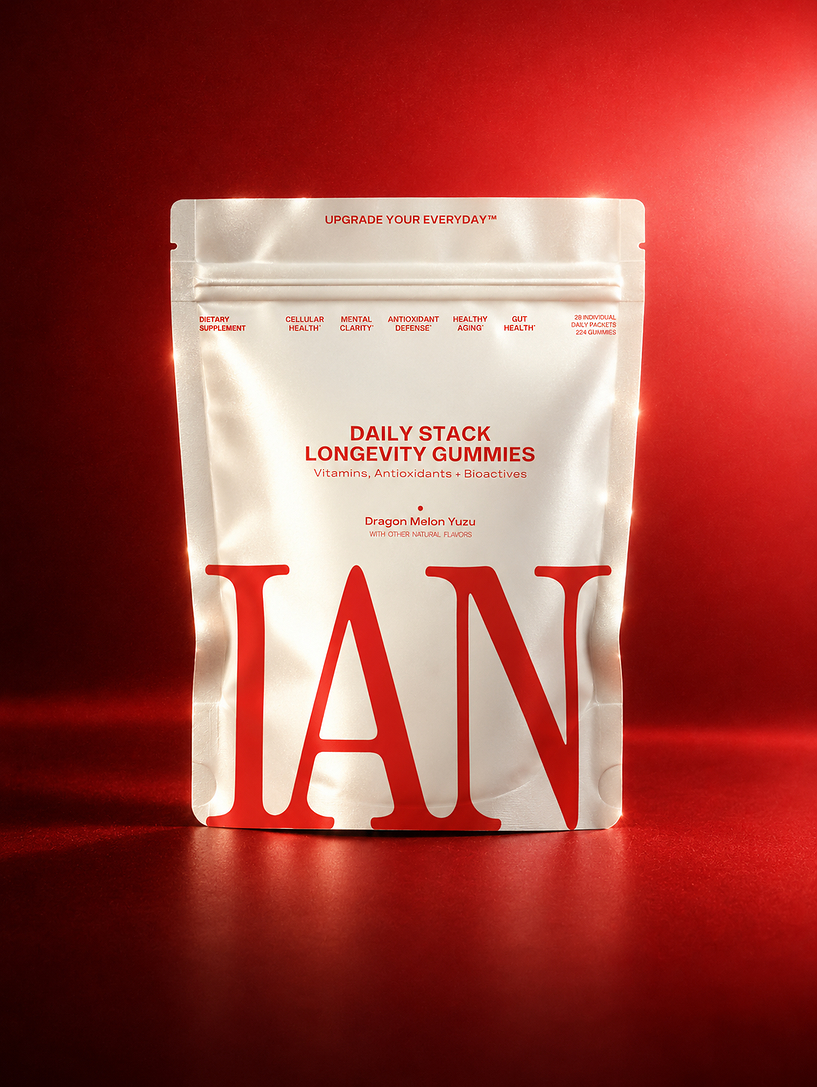
A new entrant in the crowded longevity supplement space is positioning itself around daily ritual rather than clinical complexity. IAN Cellular Health, founded by serial entrepreneur Richard Laver, debuts December 22 with a daily stack gummy featuring 24 curated ingredients aimed at mental clarity, antioxidant defense, healthy aging, and gut health — four of the most commercially active functional benefit claims in the supplement market today.
Each eight-gummy sachet delivers 10 grams of fiber, 3 grams of sugar, and 40 calories per serving in a single Dragon Melon Yuzu flavor. The macronutrient profile — high fiber, low sugar — aligns with ongoing reformulation pressure across the functional gummy category, where brands face scrutiny over sugar loads that can undercut health positioning. The portable sachet format targets on-the-go consumption occasions, a packaging strategy that has gained traction among better-for-you supplement brands chasing the morning-routine consumer.
Market Backdrop
IAN enters at a moment when healthy aging is shifting from niche to mainstream. McKinsey & Company's 2025 Future of Wellness survey found that up to 60% of consumers across markets identify healthy aging as a top or very important priority. SNS Insider estimates the broader U.S. longevity market was valued at $9.16 billion in 2025 and projects it will reach $20.17 billion by 2035 — a compound growth trajectory that has attracted both legacy supplement brands and direct-to-consumer entrants racing to establish category ownership. For operators and finished-formulation buyers, the longevity segment increasingly overlaps with gut health and prebiotic fiber trends, making multi-benefit stacks like IAN's a logical response to consumer demand for consolidation.
Founder's Pedigree
Laver's operational track record is a differentiator worth noting in a category crowded with first-time founders. He previously built Kate Farms, the plant-based medical nutrition brand that scaled into clinical and hospital channels, and Lucky Energy, a functional energy beverage. That background in both medical nutrition and mainstream functional beverages gives IAN a supply-chain and commercialization foundation that many wellness startups lack at launch. Laver describes IAN as the concluding chapter of an entrepreneurial trilogy, with ambitions to expand the brand into a broader platform of longevity-oriented products over time.
The product carries standard FDA structure-function claim disclaimers — it is not intended to diagnose, treat, cure, or prevent any disease — and IAN has not disclosed whether its 24-ingredient formula is backed by finished-product clinical data or relies on ingredient-level evidence from its constituent components. That distinction matters increasingly to supplement buyers and retail category managers evaluating claims credibility amid tightening FTC scrutiny of wellness marketing. Full ingredient disclosure is available via early-access sign-up on the brand's website, a pre-launch gating strategy that also builds a first-party data asset ahead of the December 22 commercial date.
Written by Michael Politz, Author of Guide to Restaurant Success: The Proven Process for Starting Any Restaurant Business From Scratch to Success (ISBN: 978-1-119-66896-1), Founder of Food & Beverage Magazine, the leading online magazine and resource in the industry. Designer of the Bluetooth logo and recognized in Entrepreneur Magazine's "Top 40 Under 40" for founding American Wholesale Floral, Politz is also the Co-founder of the Proof Awards and the CPG Awards and a partner in numerous consumer brands across the food and beverage sector.