
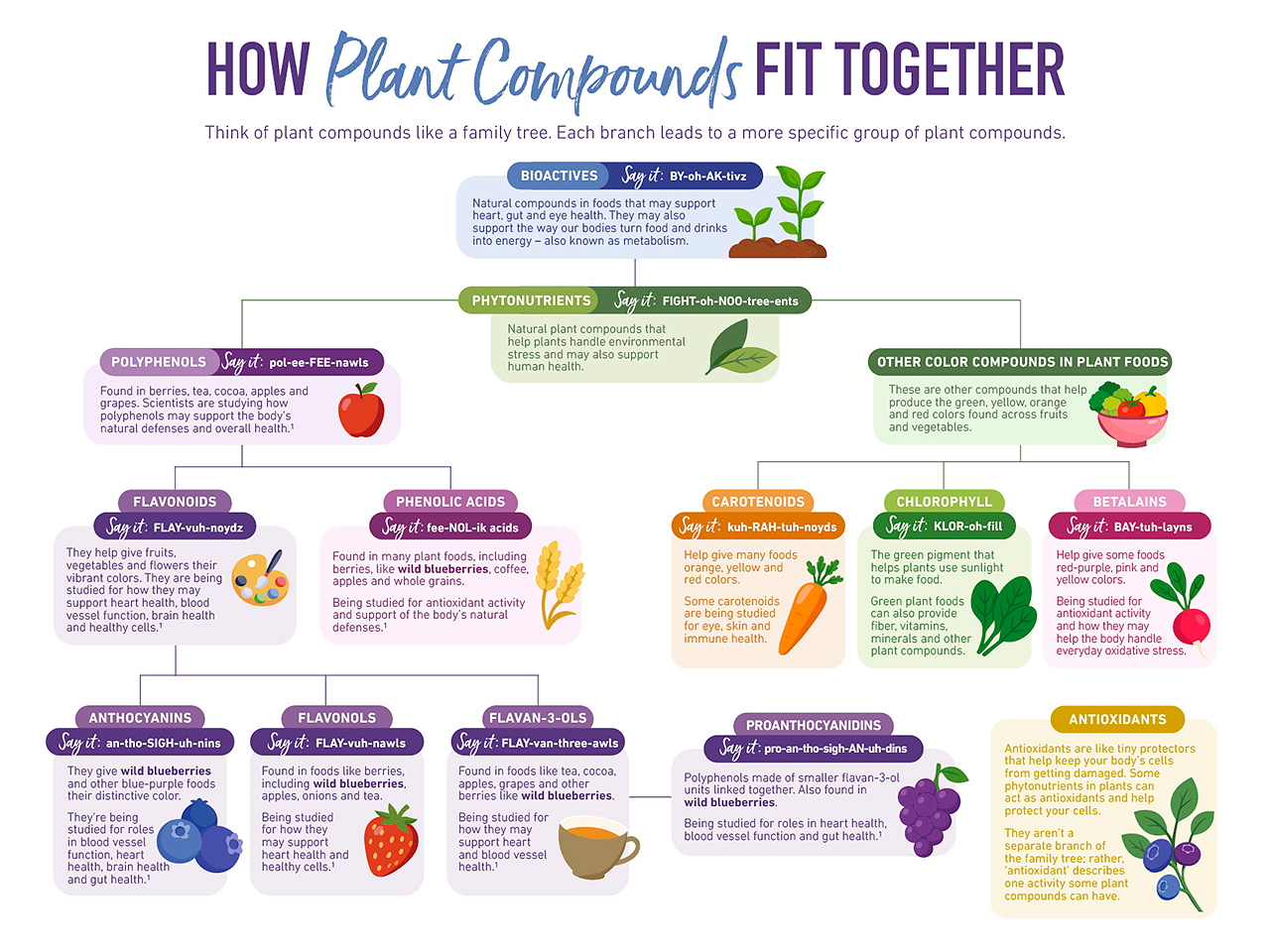
The Wild Blueberry Association of North America (WBANA) has released a free, science-backed communications resource designed to help nutrition journalists, registered dietitians, and educators explain phytonutrient terminology to general and family audiences. Titled The ABCs of Phytonutrients: A Back-to-School Guide to Wild Blueberry Plant Power, the toolkit uses wild blueberries — among the most anthocyanin-dense fruits in the North American food supply — as its primary teaching vehicle.
The Science Behind the Framework
The toolkit organizes plant compound literacy around three core terms: anthocyanins, bioactives, and color. Anthocyanins are the natural pigments responsible for wild blueberries' characteristic blue-purple hue and function as antioxidants, helping the body manage oxidative stress from everyday metabolic activity. The guide situates anthocyanins within a broader plant-compound hierarchy — bioactives → phytonutrients → polyphenols → anthocyanins — using an original "family tree" graphic that clarifies how these frequently conflated terms actually relate to one another.
The toolkit also summarizes peer-reviewed research linking wild blueberry consumption to outcomes across four clinical domains: blood vessel function, cardiometabolic health, gut health, and brain health. A 2026 review published in Critical Reviews in Food Science and Nutrition — co-authored by a multi-institutional team including researchers from institutions with established small-fruit phytochemistry programs — provides the most recent evidence anchor, examining wild blueberries' cardiometabolic potential across available human and preclinical studies.
Colleen Craig, who leads WBANA's Health Research Committee, framed the initiative as a direct response to a shift in consumer media coverage. "We've observed more consumer publications using different bioactive compound terms when talking about wild blueberries, which led to more customer questions about phytonutrients like anthocyanins and related terms like antioxidants," Craig said. The toolkit, she added, is intended as a foundational resource for anyone communicating about functional plant foods in an environment where terminology is proliferating faster than public comprehension.
Operator and Formulator Relevance
For ingredient suppliers and finished-product formulators, the release signals something beyond public education: WBANA is actively building consumer-facing vocabulary around anthocyanins and bioactives at the same moment the broader polyphenol ingredient category is accelerating. Brands positioning wild blueberry powders, concentrates, or freeze-dried inclusions in functional snacks, smoothie mixes, or fortified cereals will find a more receptive — and better-informed — retail buyer and end consumer if baseline literacy around these terms improves at the media and dietitian level.
The toolkit was developed in collaboration with Jenny Shea Rawn, MS, MPH, RD, a Maine-based registered dietitian, who applied an accessibility-first editorial standard: if the language couldn't be understood by a nine-year-old, it needed revision. The four-component package includes a phytonutrients guide with research summaries, a color-coded plant-pigment poster framed around a crayon box analogy, a kid-targeted lunchbox note with snack ideas, and a bank of story angles and communication frameworks for educators and health communicators.
Wild blueberries — native to Maine and Eastern Canada and distinct from cultivated highbush varieties in both phytochemical density and polyphenol profile — are distributed nationally through the frozen fruit aisle. WBANA represents farmers and processors across both the U.S. and Canadian sides of the production region, and the toolkit is available through both the U.S. and Canadian WBANA sites at no cost.
Written by Michael Politz, Author of Guide to Restaurant Success: The Proven Process for Starting Any Restaurant Business From Scratch to Success (ISBN: 978-1-119-66896-1), Founder of Food & Beverage Magazine, the leading online magazine and resource in the industry. Designer of the Bluetooth logo and recognized in Entrepreneur Magazine's "Top 40 Under 40" for founding American Wholesale Floral, Politz is also the Co-founder of the Proof Awards and the CPG Awards and a partner in numerous consumer brands across the food and beverage sector.